| Maintenance strategy | Core principle |
|---|---|
| Reactive or corrective maintenance | Maintenance is done when a defect or failure occurs or is detected. |
| Preventive maintenance | Maintenance tasks are carried out at defined time-based or usage-based intervals. |
| Condition-based maintenance | Actions are triggered by the asset’s current technical condition. |
| Predictive maintenance | Condition, operating, and historical data are used to determine when maintenance will be needed, or a potential failure may be imminent. |
| Prescriptive maintenance | Specific recommendations for action are derived from data and forecasts. |
Know-How
Maintenance strategies: Fundamentals, selection and support from CMMS software

Daniel Mirbach, Head of Marketing
What are maintenance strategies?
Machines and equipment are subject to technical wear and tear. Wear, corrosion, material fatigue, and other influences change their condition over time. Preventing these processes entirely would be technically complex and hardly economical. The aim of maintenance is therefore to keep assets in working condition, while keeping unavoidable wear within acceptable limits and avoiding unplanned failures wherever possible.
The tasks required to achieve this, and when they should be carried out, depend on the asset in question. If a non-critical machine fails, the consequences may be minor. By contrast, the failure of a central production asset can interrupt entire manufacturing processes, incur high costs or create safety risks. Choosing the right maintenance strategy is therefore crucial to balancing technical availability, operational safety and cost-effectiveness.
A maintenance strategy defines the principles according to which maintenance activities are planned, triggered and carried out. For example, it determines whether a company responds only after a failure, performs scheduled maintenance, or monitors an asset’s actual condition to identify the right time for maintenance.
What maintenance strategies are available?
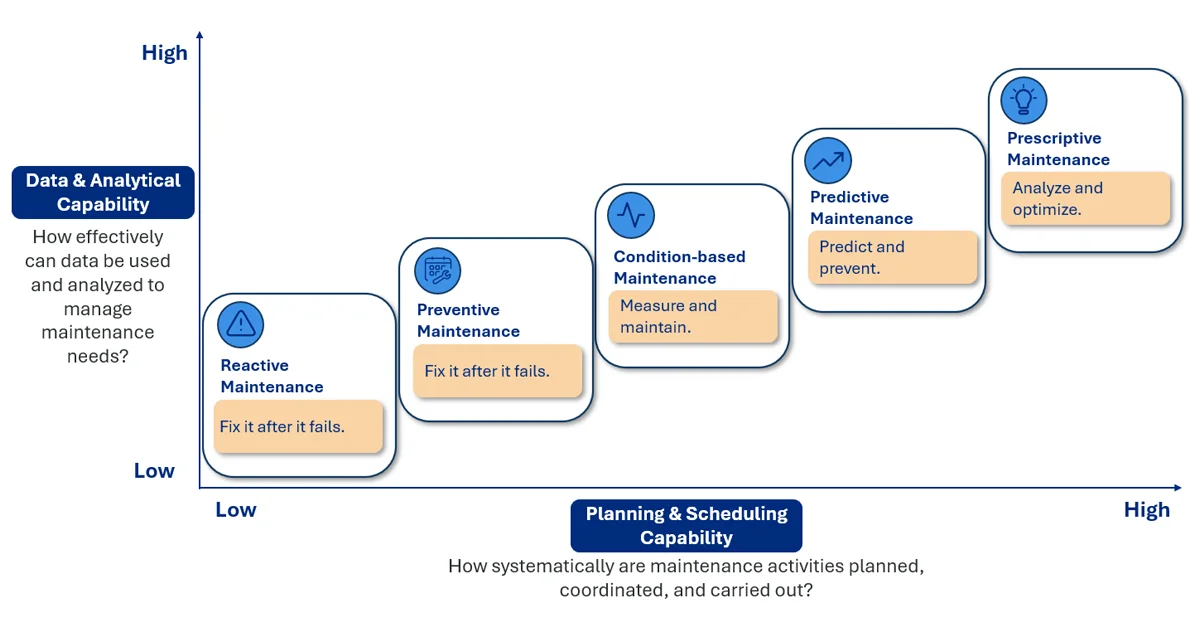
Maintenance strategies differ primarily in terms of when and on what basis a repair, maintenance, or inspection is performed. The key approaches include reactive and preventive maintenance, as well as condition-based and predictive maintenance. Prescriptive maintenance is a further development.
Maintenance strategies at a glance
While reactive maintenance responds to a fault that has already occurred, preventive and condition-based strategies act earlier to prevent failures and unexpected production disruptions. Predictive maintenance supplements condition assessment with forecasts. Prescriptive maintenance builds on predictive maintenance by adding specific maintenance recommendations.
Which maintenance strategy is right for which asset?
Choosing the right maintenance strategy depends on the technical, economic and legal conditions. Assets are therefore often classified according to their criticality, for example through a criticality assessment or ABC analysis. For critical assets, potential causes of failure are also investigated systematically, for example using an FMEA (Failure Mode and Effects Analysis) or as part of Reliability-Centered Maintenance (RCM).
The following criteria are particularly important when selecting the right strategy:
- Asset criticality and consequences of failure: How important is the asset to the company? What impact would a failure have on production, quality, costs, and safety?
- Risk assessments and requirements: What tasks are required by risk assessments, legal requirements, manufacturer specifications, and internal operating rules?
- Wear behavior and technical monitorability: How does the asset’s condition change, and can an impending failure be detected in time through inspections or measurements?
- Cost-effectiveness: How do the costs of preventive measures compare with the potential damage caused by failures and unplanned downtime?
- Data availability: What condition and operating data are available, and are they sufficient to assess maintenance needs or predict failures?
Suitability and typical applications of the different strategies
Reactive maintenance when the consequences of failure are minor
A reactive strategy may be suitable for components whose failure has no significant impact on safety, production processes or other assets, and which can be repaired or replaced quickly and cost-effectively when needed. This is provided that no binding requirements or safety-related reasons rule it out.
Preventive maintenance when intervals can be defined
Fixed maintenance and replacement intervals are based on manufacturer specifications, operating experience, or defined usage cycles. A maintenance plan specifies which maintenance tasks must be carried out at which intervals and helps organize upcoming work in advance. For example, maintenance can be coordinated with planned equipment shutdowns.
Condition-based maintenance when asset condition can be measured
If an asset’s condition can be assessed reliably, maintenance tasks can be based on its actual condition, using measurements and sensors. Typical measurement variables include vibration, temperature, pressure, wear, and lubricant quality. When defined thresholds are reached, or inspections reveal anomalies, targeted maintenance can be scheduled. Unlike predictive maintenance, the main focus is not necessarily on forecasting a future failure, but on assessing wear.
Predictive maintenance when the risk of failure is high
For assets where a failure could be very costly, it may make sense to go beyond assessing the current condition and predict future maintenance needs. This requires condition, operating, and historical data. Depending on the application, statistical methods, data models, or AI may be used. The additional investment in sensors and analysis should be proportionate to the expected benefit.
Prescriptive maintenance to optimize maintenance activities
In addition to predicting an impending failure, companies can consider spare-part availability, production planning, and available maintenance resources alongside condition and operating data. For example, a recommendation may be to replace a component during the next planned production shutdown.
Why do companies combine different strategies?
In practice, it is rarely economical to manage an entire asset base using just one maintenance strategy. Machines, assemblies and individual components differ in terms of their criticality, wear behavior and the potential consequences of failure. Companies therefore tailor the strategy to each asset or component and allocate maintenance resources where they deliver the greatest value.
Example:
| Asset / component | Criticality | Strategy | Reason |
|---|---|---|---|
| Pump C in the process line | High | Condition-based | A failure stops production. Vibration and temperature can be measured. |
| Filter on production machine A | Medium | Preventive (e.g. every 2,500 operating hours) | Wear depends on usage. Replacement can be planned effectively. |
| Operating handle on a machine guard | Low | Reactive | A defect does not directly affect the machine’s operation. Replacement is straightforward and can be carried out when needed. |
Combining different strategies helps reduce both unnecessary maintenance tasks and avoidable failures. The effort involved in inspections, maintenance, sensors, and data analysis should be weighed against the potential consequences of failure. Intensive monitoring is not economically viable for every asset. For assets that are important to production, however, it can help identify risks earlier and plan work more effectively.
The selected strategy also does not have to remain unchanged indefinitely. As more data becomes available, new technical options emerge, or production requirements change, companies can further develop their maintenance approach. For example, time-based maintenance can initially be supplemented with condition monitoring. If sufficient data becomes available later, predictive or prescriptive maintenance may also be an option.
What role do TPM, autonomous maintenance and mobile maintenance play?
For maintenance to contribute fully to the company’s value creation, work organization and employee involvement are also important. Concepts such as Total Productive Maintenance (TPM), autonomous maintenance and mobile maintenance address precisely these areas. They complement the selected strategy with organizational, practical and technical approaches that companies can use to structure and improve their maintenance processes.
Total Productive Maintenance (TPM)
Total Productive Maintenance (TPM) aims to improve Overall Equipment Effectiveness (OEE) and reduce production losses. Maintenance is treated as a shared responsibility involving not only specialist maintenance teams but also production and other departments. TPM focuses on prevention, continuous improvement, and greater employee involvement. The aim is to keep equipment running with as few disruptions as possible, detect faults early, and systematically reduce recurring problems.
Autonomous maintenance: involving production employees
Autonomous maintenance is part of TPM. Production employees take on simple maintenance tasks for the equipment they operate. These may include cleaning, visual inspections, or identifying and reporting unusual noises and other anomalies. The aim is to detect changes in an asset’s condition at an early stage. Responsibility for complex inspections and repairs remains with qualified maintenance specialists.
For this collaboration to work, tasks, responsibilities and limits must be clearly defined. For example, production employees can use digital instructions, intuitive checklists and inspection reports to carry out checks, resolve issues independently and document their work.
Mobile maintenance
Mobile maintenance supports the practical execution of work. Using a native app on smartphones or tablets, technicians can access tickets, work orders, asset history and work instructions directly at the point of work.
Synergy between the approaches
TPM, autonomous maintenance, and mobile maintenance complement one another in different ways: TPM provides the organizational framework for shared responsibility and continuous improvement. Autonomous maintenance involves production teams through clearly defined tasks. Mobile applications help maintenance technicians access asset information, carry out work, and record the results. This enables companies not only to determine which maintenance strategy is suitable for an asset, but also to establish the procedural and technical conditions needed to implement it consistently in day-to-day operations.
How CMMS software effectively supports the maintenance strategy
Maintenance management software such as the Maintastic CMMS supports the maintenance strategy and its implementation in day-to-day operations: from reporting faults for reactive maintenance to scheduling recurring maintenance tasks and incorporating condition data.
Establishing a data foundation and planning maintenance activities
Whether a company uses reactive, preventive, or condition-based maintenance, choosing the right strategy requires a sound understanding of its assets and access to relevant information.
The study Smart Maintenance by the National Academy of Science and Engineering (acatech) based in Germany illustrates the size of the gap: 57% of the companies surveyed had no data available as a basis for maintenance activities. 47% manually recorded and documented condition, fault, or failure information.1
A CMMS (Computerized Maintenance Management System) consolidates this information in one central location and links it to the relevant assets. Maintenance planning helps define recurring tasks and intervals and coordinate upcoming work.
The ABB Survey Report shows how effective consistent maintenance can be: 92% of the 3,215 maintenance professionals surveyed worldwide said maintenance had improved asset availability in the previous year. For 38%, availability increased by at least a quarter.2
Condition-based maintenance strategies can also be implemented with maintenance management software by connecting it via an API to predictive maintenance, IoT, MES, or condition monitoring systems.
- Read more about CMMS in this article: CMMS explained: Definition, key features, benefits, AI integration, and maintenance applications
Documenting processes transparently
When maintenance tasks, faults, and repairs are recorded on paper or in separate files, tracing an asset’s history often requires additional effort.
In the study, 18% of the companies surveyed did not document their processes, 28% used paper, and 23% used decentralized digital documents such as Word or Excel files.3
A CMMS software links fault reports, work orders, and completed activities to the relevant asset. Employees can document work directly at the point of service and record information such as the cause of a fault, the repair carried out, or the spare parts used. This makes asset history easier to trace and ensures that it is available for future maintenance tasks or similar faults.
Coordinating spare parts and work orders more effectively
Scheduled maintenance is of little use if the required spare parts are unavailable or responsibilities have not been clarified. Implementing a maintenance strategy therefore also requires consideration of material availability, resources, and work orders.
According to acatech, 17% used paper, 29% used Excel or Access, and 48% used an ERP system. 6% did not manage their spare parts at all.4
A CMMS can complement these systems by linking spare-part information to assets and work orders. This makes it easier to account for the materials required for a job during planning. A CMMS does not necessarily replace the ERP system. Instead, it can complement it effectively through integration. The key is to make relevant information available and ensure that the systems involved work well together.
- Case study Vetter: Find out how more than 350 production and maintenance specialists work with Maintastic thanks to successful SAP integration in this case study: Efficient pharmaceutical maintenance
Preserving knowledge and supporting technicians
Effective maintenance depends on more than plans and data. Technicians’ practical experience is equally important: Which faults occur frequently? What causes have already been identified? What has helped resolve them?
After all, 27% of the companies surveyed had no standardized way of providing knowledge. Knowledge was held by individuals and passed on verbally. A further 32% provided standardized knowledge on paper, without a systematic process for expanding that knowledge.5
Digital work instructions for standard operating procedures (SOPs), interactive checklists and forms help resolve faults, capture knowledge in a structured way and make it available in day-to-day work. Integrated AI can also help preserve knowledge by capturing expertise through a voice agent.
Carrying out work orders on the shop floor
CMMS software brings all relevant information to the shop floor and enables technicians to work on the move.
The perceived benefits of mobile devices include, in particular, support with carrying out tasks (45%) and better documentation of work (35%).6 The 2026 State of Manufacturing Operations & Maintenance Study by Plant Engineering also highlights their importance: 49% of respondents consider mobile applications particularly critical to the future success of manufacturing facilities.7
Using a CMMS app, technicians can view work orders, complete inspection records, report faults, and record completed work immediately. This eliminates the need to transfer paper forms or notes into a system afterwards.
Using KPIs to further develop the strategy
Metrics such as MTTR (Mean Time to Repair) and MTBF (Mean Time Between Failures), OEE and the maintenance backlog can help identify weaknesses in the strategy. A CMMS analyses information from maintenance tasks, faults, as well as work orders and consolidates it in a dashboard. This enables companies to collect and track KPIs.8
Conclusion
Choosing the right maintenance strategy depends on an asset’s criticality, technical condition and economic circumstances. In practice, companies often combine different approaches: reactive maintenance where failures have no significant consequences, preventive maintenance where wear can be planned for, and condition-based or predictive maintenance where failures are costly and sufficient data is available. Concepts such as TPM and autonomous maintenance involve production teams and support implementation in day-to-day operations.
CMMS software provides the foundation for this. It makes maintenance activities easier to plan, keeps asset history, fault knowledge, and documentation centrally available, and provides KPIs that can be used to review and adjust the selected strategy as needed. Mobile applications bring this information directly to the asset.
3, 4, 5, 6 acatech (2019): Smart Maintenance, pages 19-21, 37
8 acatech (2019): Smart Maintenance, pages 24-25
Product
Features
AI Agent
Speak. Save time. Improve quality.
Asset Management
Manage all assets centrally
Maintenance Ticketing
From malfunction to solution
Maintenance Planning
Plan single and recurring work orders
Work Orders
Complete orders & tasks with ease
Work Instructions & SOPs
Capture & share expert knowledge
Collaboration
Connect with video support & chats
API & Integration
Create seamless processes
White-Label Options
Customize Maintastic
Deployment Options
Cloud or on-premise
Use cases
Maintenance (CMMS)
Plan, respond, & optimize
Mobile Maintenance
Manage tickets and work orders from the shop floor
Preventive Maintenance
Efficient planning & mobile work order execution
Customer Service
Digital business models for customer service
Industries
General Manufacturing
Ensure optimal equipment effectiveness
Pharma & Life Sciences
Prevent downtimes in regulated environments
Chemicals
Keep plants running safely and stay compliant
Food & Beverage
Mastering tight maintenance windows
Construction & Mining
Maximum uptime for mobile machinery
Energy & Utilities
Reliable maintenance for energy and utilities
Transportation & Logistics
Smooth operations for resilient supply chains
Defense & Security
Ensure reliable processes in national security
Resources
Discover & Decide
Customer Success
Leverage the full potential of digital maintenance
News Blog
Best practices, trends & news
Knowledge Hub
Advanced maintenance & service knowledge
Connect with us
Events
Let’s connect – in person or online!
Jobs & Careers
More than just a job. Explore our openings.
About Maintastic
What drives us: vision & mission
Contact
Reach us your way – email, call, or visit us!
Helpdesk
App Download Center
Get the latest version of Maintastic
Release Notes & Support
Updates, improvements & help
Login
Log in to your workspace
You are currently viewing a placeholder content from Vimeo. To access the actual content, click the button below. Please note that doing so will share data with third-party providers.
More InformationYou are currently viewing a placeholder content from YouTube. To access the actual content, click the button below. Please note that doing so will share data with third-party providers.
More InformationYou need to load content from reCAPTCHA to submit the form. Please note that doing so will share data with third-party providers.
More InformationYou are currently viewing a placeholder content from Facebook. To access the actual content, click the button below. Please note that doing so will share data with third-party providers.
More InformationYou are currently viewing a placeholder content from Instagram. To access the actual content, click the button below. Please note that doing so will share data with third-party providers.
More InformationYou are currently viewing a placeholder content from X. To access the actual content, click the button below. Please note that doing so will share data with third-party providers.
More Information