Content
Efficient pharmaceutical maintenance: How Vetter advances cleanroom manufacturing with Maintastic

Daniel Mirbach, Head of Marketing
| 8 Min. read
| 8 Min. read

Aachen, October 15, 2025 – In pharmaceutical manufacturing, the responsibilities for product quality, patient safety, and regulatory compliance are clearly defined. However, when it comes to digital tools, the line between GMP and non-GMP activities can become blurred. Not every task in a Good Manufacturing Practice (GMP) environment needs to be handled by GMP-compliant software. Especially for maintenance and support processes, non-GMP tools can deliver value without interfering with the pharmaceutical process or product.
This article explores how
Maintastic supports cleanroom manufacturing and maintenance in the pharmaceutical industry without affecting GMP-compliant activities. It outlines common use cases, explains the benefits, and highlights how the pharmaceutical service provider Vetter applies this approach in practice.
Not all operations require GMP-compliant software
GMP compliance is essential for software wherever product quality, patient safety, or regulatory compliance is directly affected. These systems typically control or document processes critical to patient safety or the identity, strength, quality, or purity of the product. Examples include Manufacturing Execution Systems (MES), Supervisory Control and Data Acquisition (SCADA), electronic Batch Records (eBR), and Laboratory Information Management Systems (LIMS).
What distinguishes GMP-compliant software from other software is its function and impact on regulated processes. If a system influences batch release decisions, stores or processes GMP-relevant data, generates official GMP documentation, or forms part of a computerized system in accordance with Annex 11 of the GMP rules of the EU, it usually becomes subject to GMP requirements and must be validated accordingly. This includes:
- Full lifecycle documentation (URSUser Requirements Specification, FSFunctional Specification, DSDesign Specification etc.)
- Risk-based validation
- Change control and versioning
- Periodic review and revalidation
Regulatory expectations are defined, among others, in EU GMP Annex 11 Computerised Systems, 21 CFR Part 11 Electronic Records and Signatures (US FDA), and ISPE GAMP 5 Risk-Based Approach to Computerized Systems.
However, not every task in a GMP-regulated environment needs a GMP-compliant system. In many cases, using validated systems for every support activity creates an unnecessary burden. Tasks like maintenance coordination, troubleshooting, service documentation, or accessing non-critical data, non-GMP tools offer a more agile solution. This requires that they do not influence the process, do not generate GMP records, and are therefore separate from decision-relevant systems.
Advantages include:
Faster
deployment
Validation is not required if the system is not used in GMP-relevant processes.
Greater
flexibility
Easy to adjust configurations, users, and workflows.
Reduced
compliance overhead
Risk-based approach instead of full Computerized System Validation (CSV) lifecycle.
Lower
costs
Less effort for documentation, and audits.
The terms “non-GMP software” and “non-GMP tool” are not formally defined but are used by pharmaceutical companies to describe systems that support GMP-regulated environments without directly influencing product quality, patient safety, or regulatory compliance. These solutions can be classified internally as outside the scope of GMP.
Cleanroom manufacturing needs smart support
Cleanroom operations are among the most tightly controlled environments in pharmaceutical manufacturing. Every person entering must follow strict gowning procedures. Each new access increases the risk of contamination and disrupts production flow.
To mitigate these risks, cleanroom teams increasingly rely on digital support tools for maintenance and troubleshooting. These systems can:
- Enable remote support video calls between the cleanroom and maintenance staff
- Help reduce the need for physical entry into classified cleanroom areas (e.g., grade A/B)
- Provide access to equipment overviews, technical documentation, or prior incident data
- Standardize how technical issues are reported and resolved

Maintastic, for instance, allows cleanroom personnel to log issues at the point of detection via QR code, mobile app, or voice input without disrupting GMP systems or requiring physical intervention from external staff.
Use cases and boundaries
In GMP-regulated environments, defining the role of each system is crucial. Non-GMP software plays a valuable role in supporting cleanroom operations. The distinction is supported by industry frameworks such as the ISPE Good Practice Guide for Operations & Maintenance and other risk-based approaches to system classification.
Where maintenance systems add value without interfering
Maintenance support systems such as Maintastic are useful where agility, collaboration, and transparency are needed, but without crossing into GMP-relevant decision-making. For example, the system can be used to document service events, facilitate communication, plan maintenance activities, and access equipment-related information like manuals. It helps teams work more efficiently without creating or modifying GMP data.
According to ISPE guidance, maintenance and asset management systems may remain outside the validation scope if they have no direct impact on the manufacturing process or batch documentation. Features such as ticketing, service tracking, digital collaboration, or guided troubleshooting fall within this low-risk category.
Where the limits lie
A non-GMP-compliant software solution must not control, generate, or alter GMP-relevant data. It must also remain separated from validated systems. This means:
- No interaction with process parameters
- No involvement in batch record creation or release decisions
- No bidirectional interfaces with MES, SCADA, or LIMS
- No hosting of controlled documents like master instructions (e.g., manufacturing instructions for a medicinal product or active ingredient) or specifications
Crossing these boundaries would shift the system into the GMP category, requiring full validation and lifecycle documentation.
| The maintenance management system supports | It does not |
|---|---|
| Logging technical issues (e.g., asset breakdowns) | Creating or modifying GMP documents |
| Enabling video collaboration and chat communication | Controlling process parameters |
| Accessing equipment-related documents (e.g., manuals) and historical service data | Releasing or approving GMP batches |
| Planning and tracking maintenance activities | Hosting controlled documents (e.g., master instructions) |
| Creating and managing service tickets | Integrating in a way that affects GMP-critical systems (e.g., MES, SCADA, or LIMS) |
| Facilitating knowledge transfer and troubleshooting documentation | Replacing validated GMP systems |
By keeping well-defined boundaries, companies can benefit from modern, digital support systems without compromising GMP compliance.
Case Study: How Vetter introduces Maintastic to support cleanroom operations
Vetter is a leading Contract Development and Manufacturing Organization (CDMO) specializing in aseptic production. Headquartered in Ravensburg, Germany, and supported by more than 7,000 employees, Vetter operates manufacturing sites across Europe and the United States. As a family-owned business with global reach, the company plays a key role in the reliable supply of pharmaceutical products worldwide.
To increase reliability in cleanroom operations, Vetter introduced Maintastic in late 2024 as a cutting-edge software tailored to the unique needs of maintenance, repair, and breakdown management.
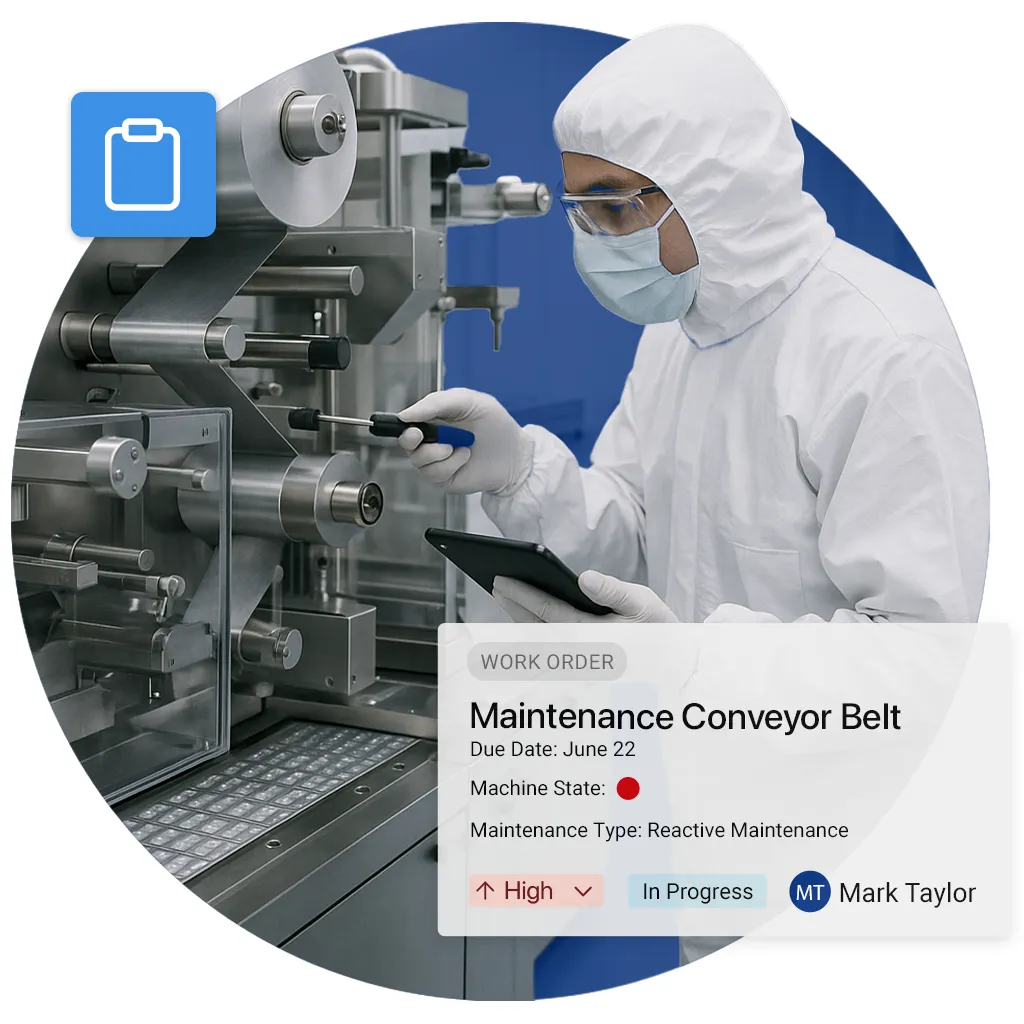
Initial situation
Before implementing Maintastic, the CDMO faced several challenges in its cleanroom production areas.
- Unnecessary cleanroom traffic: Various controlled zones must be passed through before entering the cleanroom. Even minor issues often required physical presence, which increased both the risk of contamination and the time required.
- Fragmented collaboration: Information was distributed across multiple actors, like operators inside the cleanroom, technicians working in related areas, to external equipment suppliers supporting from outside. Aligning all parties was time-consuming and prone to delays.
- Efficient knowledge management: Access to machine history or past service cases was limited. As a result, valuable expertise was not easily shareable across departments or sites, slowing down the resolution of recurring technical issues.
Process improvements
To address these challenges, Vetter implemented Maintastic for cleanroom-related maintenance and service processes. Key features include:
- Live collaboration from inside the cleanroom: Maintastic enables real-time cooperation via integrated video, chat, and documentation that are all linked directly to the relevant machine and service ticket. Features such as Augmented Reality (AR) annotations, background blurring, and facial anonymization support secure and context-rich communication.
- Integration with existing ERP system SAP: Asset data, including equipment master records and technical location, is transferred one-way from SAP to Maintastic. This ensures consistency while SAP remains the authoritative source.
- Centralized solution knowledge: A filterable ticketing system allows teams to document, search, and reuse solutions across similar incidents. This makes accumulated knowledge easily accessible even across sites.

Digital systems like Maintastic help us manage complexity while raising efficiency and responsiveness in our production to a whole new level.
Fabian Mildenberger
Head of Service & Process Automation with 15 years of maintenance experience,
Vetter, 7,300+ employees
Vetter, 7,300+ employees
Results
Maintastic is now used daily by more than 350 professionals in production and maintenance.
Faster communication and increased uptime
Targeted interaction between various actors helps resolve issues more quickly. In some cases, avoiding unnecessary cleanroom entries saves up to 20 to 30 minutes per incident.
Improved documentation and shared knowledge
Tickets now include structured entries with images, video, and comments. This improves data quality and supports knowledge transfer across Vetter’s production sites.
Scalable, future-ready platform
A second rollout is underway to include additional production staff. Future enhancements include AI-driven features such as speech-to-ticket and modules for preventive maintenance.
Further reading:
(Original article by Vetter, CDMO Insights, June 4, 2025)
Conclusion: Strengthening cleanroom operations through modern maintenance systems
Digitalization in sophisticated and highly regulated production environments is not limited to only GMP-validated systems. As this article shows, non-GMP software makes a measurable difference by speeding up maintenance and troubleshooting, minimizing cleanroom traffic, preventing downtime, and enabling knowledge transfer.
Maintastic demonstrates how pharmaceutical manufacturers can support operational excellence without touching the product or process. The software equips maintenance managers with the tools they need to ensure the efficient operation of pharmaceutical machinery and equipment.
Disclaimer
“GMP-compliant software” is an established regulatory term used to describe computerized systems that are subject to validation and compliance requirements. In contrast, “non-GMP software” is not officially defined and can be used within companies to distinguish systems that support but do not directly impact GMP-regulated processes. The classification of software depends on its specific use and integration within a regulated environment. This article does not constitute regulatory guidance. For compliance decisions, please refer to your internal Quality Assurance and Computerized System Validation (CSV) teams or applicable authorities.
FAQ: Maintastic in pharmaceutical maintenance and cleanroom operations
What are typical use cases for Maintastic in pharmaceutical production?
Maintastic is used to digitally support maintenance processes in cleanroom environments, including issue reporting, maintenance planning, service ticketing, remote video support, and knowledge sharing across multiple sites.
What are the benefits of using Maintastic maintenance software in cleanroom operations?
By using Maintastic, pharmaceutical companies can reduce unnecessary cleanroom entries, lower contamination risks, improve documentation, shorten response times, and increase equipment availability.
What is the difference between GMP and non-GMP software?
GMP-compliant software is required whenever a system processes data or documents that directly impact product quality, patient safety, or regulatory compliance. Non-GMP software, on the other hand, supports processes such as maintenance or troubleshooting and operates outside the scope of GMP requirements.
Ready to optimize your cleanroom processes?
Book a live demo with one of our experts to see Maintastic in action. Prefer to dive right in? Start your free trial today.