Content
- Where do SMEs stand today? A snapshot
- Why SMEs focus on optimizing maintenance processes
- When maintenance reaches its limits
- Trends and approaches for SMEs in 2026
- What SMEs need from modern maintenance solutions
- Maintastic as an example of intuitive maintenance software (CMMS) for SMEs
- Conclusion: Purposefully advancing maintenance in SMEs
Industrial maintenance software: Why SMEs are switching to intuitive solutions by 2026

Daniel Mirbach, Head of Marketing
| 14 Min. read
| 14 Min. read

Maintenance plays a decisive role in the economic success of small and medium-sized enterprises (SMEs). It keeps machines available, ensures that disruptions are resolved promptly, and thereby secures ongoing production. How these tasks are organized depends, among other factors, on the size of the machine base and the available personnel resources. Modern industrial maintenance software can address this gap directly, helping SMEs structure their operations without adding unnecessary complexity to existing processes.
- Do the maintenance software tools currently in use still fit your daily operations?
- Is a systematic further development of maintenance processes required?
- And what contribution can industrial maintenance software make to optimizing processes in SMEs?
This article provides an overview of where SMEs stand today in terms of maintenance, which challenges and trends are driving the willingness to change, and which key levers exist for a modern, future-ready maintenance setup.
Where do SMEs stand today? A snapshot
Fewer than half of small and medium-sized enterprises in the European Union (EU) use enterprise resource planning (ERP) systems to manage their business processes across departments.1 As a result, digital integration remains limited, and information continues to be stored in separate systems rather than being centrally connected.
This hesitation is also reflected in daily operations. A German study of more than 300 companies found that 82% of SMEs still rely predominantly on manual or only partially automated processes, indicating a generally low level of digital maturity in many organizations.2
Only about one in three companies currently achieves a high or very high level of digital intensity. As a company grows, the availability of resources, as well as the level of digitalization and innovation, increases. While approximately 58% of SMEs in the EU engage in innovation activities, this share rises to more than 85% among large enterprises.3 SMEs tend to focus more strongly on product innovation, while process innovation is pursued far less frequently.
The reasons for this are understandable. According to the 2025 Digitalization Survey of the German Chamber of Industry and Commerce (DIHK), 60% of companies cite a lack of time for digitalization projects.4 54% perceive digitalization as too complex, and 42% view it as too expensive. At the same time, the potential becomes evident:
Companies that successfully digitalize their maintenance processes report average maintenance cost reductions of 18%.5 These benefits are driven primarily by practical, software-supported improvements in day-to-day operations – such as transparent maintenance plans, structured handling of faults, and consistent documentation of maintenance activities.
This overall situation helps explain why many SMEs are beginning to reassess key processes, especially in areas where availability, technical knowledge, and efficiency intersect directly, such as maintenance.
While the figures cited are based on studies from the European Union and Germany, they can be seen as representative indicators for challenges faced by many small and medium-sized enterprises in comparable industrial environments.
Why SMEs focus on optimizing industrial maintenance processes
Maintenance is becoming an increasingly central focus for small and medium-sized enterprises because several critical challenges converge in this area. One of the most important drivers is the cost of unplanned downtime. The Value of Reliability study by ABB shows that unplanned outages cost companies approximately $125,000 per hour.6
What makes this particularly critical is not only the direct production loss. If SMEs are unable to deliver reliably, they may face contractual penalties, declining supplier ratings, or, in extreme cases, the loss of their status as a preferred or approved supplier. For many companies, this can have tangible and long-term effects on capacity utilization and competitiveness.
Another key factor is the shortage of skilled labor. Maintenance is highly knowledge-driven: experience, asset-specific know-how, and decision-making capabilities are essential to preventing failures or resolving issues quickly. At the same time, qualified personnel are increasingly scarce, while experienced employees leave the company or approach retirement. This increases dependency on individual experts and makes existing processes more vulnerable.
Against this backdrop, many SMEs are recognizing that maintenance can no longer be organized primarily in a reactive manner. Traditional approaches such as manual documentation and compliance tracking, paper‑based and Excel‑driven procedures, or reliance on person‑dependent knowledge quickly become suboptimal once complexity, cost pressure, and limited resources converge.
Maintenance processes thereby emerge as a critical lever for operational stability, efficiency, and economic performance.
Improved planning, structured documentation, and clearly defined responsibilities can help reduce downtime, shorten response times, and provide targeted relief for skilled workers. For many SMEs, maintenance is therefore one of the areas where organizational and digital improvements deliver immediate and tangible benefits.
When maintenance reaches its limits

In small and medium-sized enterprises, maintenance has often evolved organically over time. Processes were pragmatically adapted to immediate needs – such as planning maintenance activities in Excel – responsibilities were clearly assigned, and problems were resolved directly in day-to-day operations. This approach worked well for a long time as long as the machine base remained manageable, teams stayed small, and experiential knowledge was retained within the organization.
As complexity increases, however, these structures come under pressure. Assets are operated for longer periods, new machines are added, dependencies grow, and production processes become more tightly interconnected. Requirements for availability, response speed, and transparency continue to rise. Maintenance is no longer just about repairing and servicing equipment, but also about coordinating activities, aligning stakeholders, and ensuring proper documentation.
Traditional approaches are still often highly reactive. Around 21% of surveyed companies continue to follow a run-to-failure strategy, meaning that issues are addressed only once they occur.7
Information about asset conditions, completed work, or open tasks is often scattered across different files, emails, paper forms, or embedded in technicians’ knowledge. This significantly complicates process documentation and traceability.
In addition, many organizations become highly dependent on specific individuals. Practical experience, typical failure patterns, or proven solution approaches are often not systematically documented but exist as implicit knowledge. When a key person is unavailable or leaves the company, valuable information is lost. New employees then have to rebuild this knowledge over time, which extends response times and increases the likelihood of errors.
Coordination becomes more demanding as well. As soon as multiple stakeholders are involved in maintenance, such as shift teams, external service providers, or adjacent departments like production and quality assurance, the coordination effort increases. Without a shared and up-to-date information base, follow-up questions, duplicate work, or delays become common.
In such an environment, manual or only partially digitalized processes begin to reach their limits. While they are flexible and familiar in regular operations, they are difficult to scale and become increasingly error-prone as complexity grows. What works well in smaller, more manageable contexts can, under the combined pressure of multiple factors, lead to a gradual overload of existing processes..
As a result, the perception of maintenance changes from a set of isolated tasks to an organizational process that must keep pace with company growth. This realization marks the transition from incremental optimization toward the question of how maintenance should be structured, supported, and reliably executed on an ongoing basis.
The transformation of industrial maintenance: Trends and approaches for SMEs in 2026
The developments outlined above are driving a fundamental change in how maintenance is approached in SMEs. While maintenance was previously focused primarily on short-term fault resolution, the emphasis today is on preventing failures and ensuring reliable control of processes. As a result, the focus is shifting away from purely reactive action toward greater predictability and foresight.
According to the survey, 92% of the 3,215 maintenance managers stated that maintenance helped improve asset availability over the past year, with 38% reporting an increase of at least 25%.8
Another trend shaping the transformation of maintenance is the adoption of predictive maintenance. The State of Manufacturing Operations 2025 survey conducted by Plant Engineering shows that 74% of the industrial companies surveyed consider predictive maintenance to be critical to the future success of their manufacturing operations.9
Beyond that, the demand for mobile ways of working is increasing. 33% of respondents consider mobile apps for maintenance to be a core component of modern maintenance strategies.10
Artificial intelligence (AI) is becoming increasingly valuable. Recent studies show that roughly one in five SMEs in the EU now uses AI.11 And for good reason, as generative AI has a positive impact on collaboration, knowledge sharing, and overall performance.
Professionals who have adopted AI as a working tool achieve results comparable to teams without AI, while requiring, on average 16.4 % less time and being better able to bridge knowledge gaps.12
What SMEs need from industrial maintenance software today
The challenges and developments outlined above indicate the direction in which industrial maintenance is evolving. In practical terms, SMEs require solutions that are straightforward and easy to use. Highly complex systems are often perceived as an additional burden, which leads to lower acceptance among maintenance teams and, ultimately, causes such solutions to fail during implementation.
What matters most is the ability of maintenance software to effectively support processes in small and medium-sized industrial environments, improve productivity, positively impact Overall Equipment Effectiveness (OEE), and reduce Mean Time to Repair (MTTR).
Maintastic is an example of maintenance software that addresses the requirements of small and medium-sized enterprises. At its core, it is a cloud-based Computerized Maintenance Management System (CMMS) that is built to digitally map existing maintenance processes and support a gradual transition from a predominantly reactive mode of operation to a more structured, preventive maintenance strategy.
The CMMS facilitates the shift from manual, paper-based processes or Excel spreadsheets to a centralized, digital organization of maintenance. This includes lean asset managementfor managing machines and equipment, issue and fault reporting, preventive maintenance planning
, digital checklists, instructions, and forms for standard operating procedures (SOPs), as well as the mobile execution of work orders. Feedback, documentation, and work order completion are handled directly within the CMMS app on smartphones and tablets.
Discover the untapped potential in your maintenance operations
Let’s explore it together in a personal conversation.
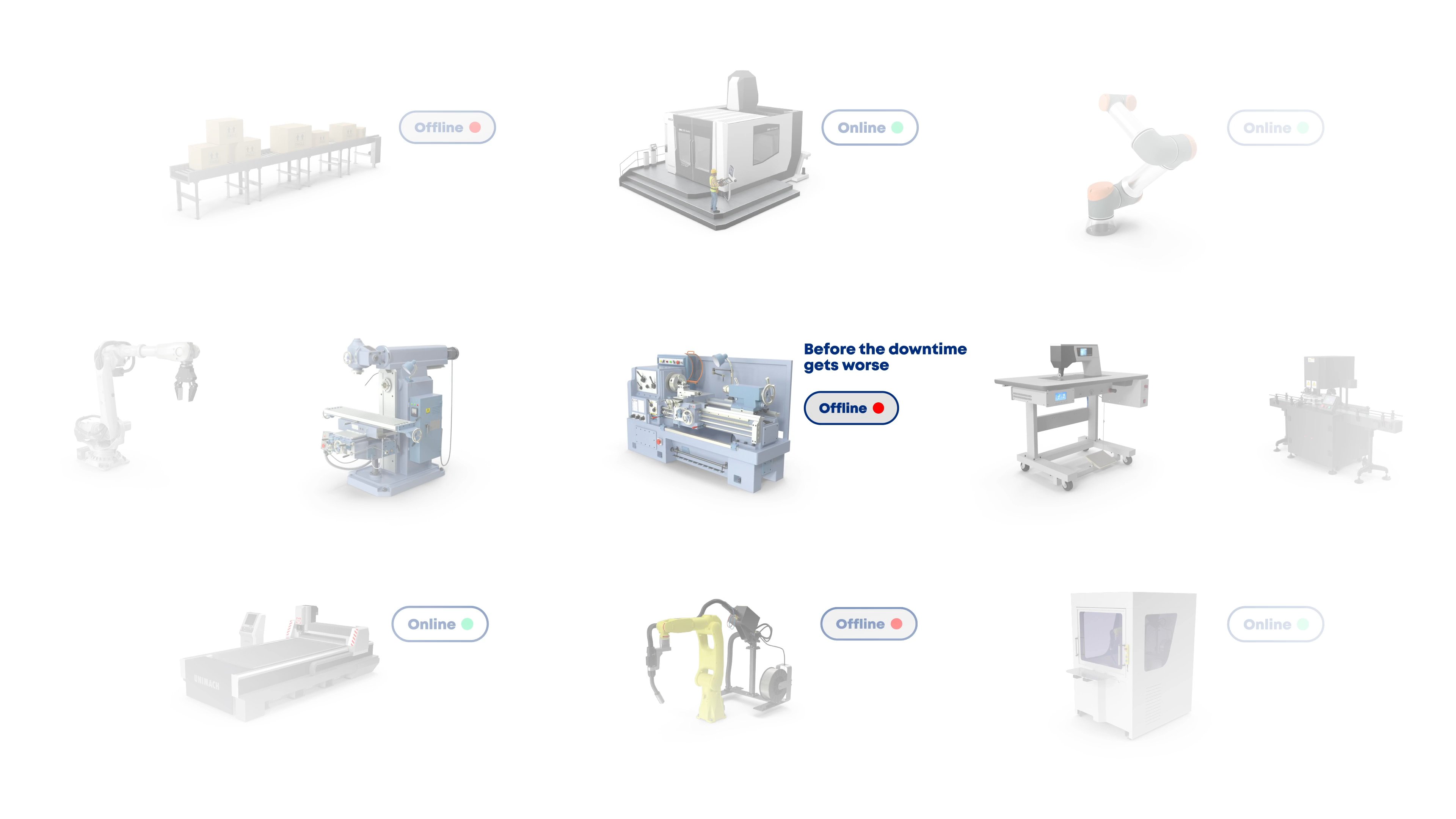
The CMMS also leverages modern AI technology. The integrated AI agent enables voice-based issue reporting in any language, automatically translates inputs, and creates tickets with a high level of data quality.
These capabilities are complemented by live collaboration features via video and chat, as well as a powerful API that enables integration with existing ERP, MES, or condition monitoring systems.


Conclusion: Purposefully advancing maintenance in SMEs
The challenges and trends outlined above illustrate why small and medium-sized industrial companies are re-evaluating their maintenance practices and actively seeking modern industrial maintenance software. The objective is to better structure processes, prevent downtime, and continuously improve key performance indicators such as OEE and MTTR in order to meet increasing requirements for documentation, knowledge transfer, asset availability, and operational efficiency. Crucial to the successful implementation of maintenance software are simplicity, reduced complexity, and user acceptance in daily operations.
FAQ: Common questions about advancing maintenance in SMEs
When does the use of maintenance software make sense for SMEs?
Maintenance software becomes particularly useful once manual or Excel-based processes begin to reach their limits. Typical indicators include increasing documentation effort, limited transparency around maintenance activities and faults, growing dependency on individual employees, or longer response times in the event of failures. The more complex the machine base and the higher the requirements for availability and traceability, the greater the benefits of digitally supported maintenance processes.
How do I switch from paper-based maintenance to CMMS?
The transition typically starts with a review of existing paper records, checklists, and maintenance logs to determine which processes should be digitized first. Assets and equipment are entered into the CMMS, followed by the setup of preventive maintenance schedules and standardized digital checklists that mirror existing paper-based procedures. A phased rollout, starting with a single team, production line, or site, allows employees to build confidence with the new system before expanding it further. Providing mobile access from the outset is important, since many maintenance tasks are carried out directly on the shop floor rather than at a desk. Clear responsibilities and short training sessions help ensure the switch is adopted in daily operations rather than reverting to paper.
Why do factories struggle without modern CMMS software?
Without a CMMS, maintenance information is often scattered across paper forms, spreadsheets, and individual knowledge, making it difficult to track asset history, plan preventive maintenance, or respond quickly to failures. This typically results in higher unplanned downtime, since issues are addressed reactively rather than anticipated through structured planning. Dependency on individual employees also increases, as experience and troubleshooting knowledge are rarely documented systematically. Over time, this makes maintenance processes harder to scale, particularly as the number of assets, shifts, or production sites grows. Factories relying on manual methods also face challenges providing the documentation required for audits, certifications, or internal reporting, since records are not centrally accessible or consistently maintained.
Does maintenance software replace the experience and expertise of employees?
No. Maintenance software does not replace technical expertise; rather, it helps organizations make better use of existing knowledge and ensure it remains accessible. Through structured documentation, standardized procedures, and digital instructions, experiential knowledge is preserved and made available to the entire team. This reduces the burden on skilled workers and, in particular, simplifies onboarding, handovers, and collaboration.
What role do KPIs such as OEE and MTTR play for SMEs?
Key performance indicators (KPIs) such as Overall Equipment Effectiveness (OEE) and Mean Time to Repair (MTTR) help SMEs measure the performance of their maintenance operations. OEE provides insight into actual equipment productivity, while MTTR indicates how quickly faults are resolved. A structured maintenance organization forms the foundation for actively influencing and systematically improving these metrics.
What should SMEs focus on when selecting industrial maintenance software?
Key factors are simplicity, reduced complexity, and acceptance in daily operations. The software should be easy to implement without the need for a complex IT project and should meaningfully support existing processes. A clear and focused feature set, mobile usability, and an intuitive user interface play a decisive role in ensuring adoption and enabling the solution to deliver real value.
Is your maintenance organization ready for the next step?
Learn how maintenance processes in SMEs can be further developed practically and effectively. During a personal software walkthrough, we will show you how Maintastic supports maintenance teams in their day to day work. Alternatively, you can explore Maintastic on your own and start a 14-day free trial.