Inhalt
- Voice-to-Ticket and AI simply explained
- Maintenance in practice
- Scenarios for AI-powered ticketing
- Advantages of AI-powered ticketing for technicians and maintenance teams
- AI-powered ticketing at Maintastic with Voice-to-Ticket
- Voice-controlled systems and data privacy
- Why AI in the workplace is a practical advantage, not a risk
- Maintastic CMMS – more than just a ticketing system
- Frequently asked questions about AI-powered ticket creation
AI-powered ticketing in maintenance: how voice input simplifies your daily operations
Vanessa Carolin Schröder, Online Marketing Manager
| 19 Min. read
| 19 Min. read
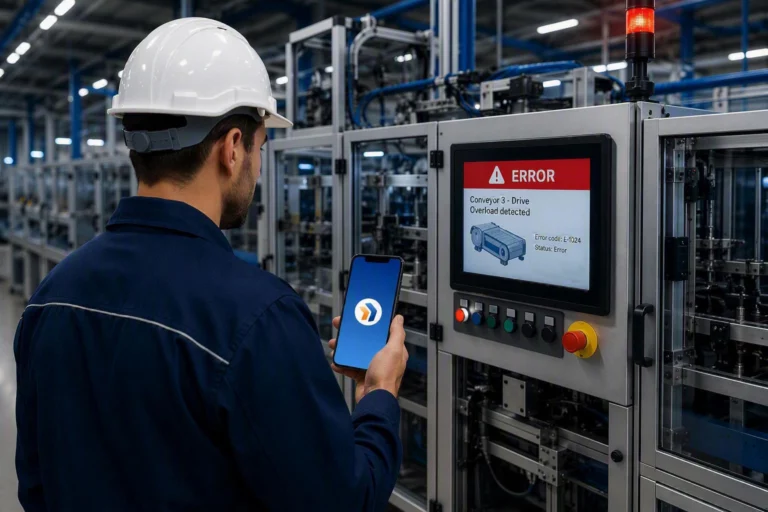
AI-powered ticketing in maintenance is changing the way companies respond to equipment failures. As a core part of reactive maintenance – where every second counts – unplanned downtime doesn’t just affect a single machine. In the worst case, one failure triggers a chain reaction across the entire production line. For small and mid-sized manufacturers, that’s not a theoretical risk. It’s a recurring operational reality.
The faster a fault is reported, and the more detail that reaches the maintenance team, the faster the response. That means getting a complete maintenance ticket into the system without leaving the machine, walking to a PC, or calling a supervisor. A maintenance software with an integrated Ticketing System is the starting point – but AI-powered ticketing through voice input takes it a step further. Using an AI Agent, production staff can report faults directly from the shop floor, hands-free, in their own words.
In this article, you’ll learn how the AI maintenance agent in Maintastic supports you in:
- Creating detailed maintenance tickets using Voice-to-Ticket technology
- Reporting issues with full context – directly at the point of failure
- Capturing information even when wearing gloves or working under time pressure
- Replacing handwritten notes and verbal handovers with structured, system-ready data.
What is AI-powered ticketing? Voice-to-Ticket and AI simply explained
Speech assistants have become part of everyday life. In Germany alone, around 57% of people over the age of 16 use them regularly – 97% of them exclusively on their smartphone, for search queries, information requests, and similar tasks.1 But what exactly is a speech assistant, and at what point does AI enter the picture – and in what form?
What is a speech assistant – and what can it do?
Speech assistants are already part of many everyday situations. Siri and Alexa, as well as the voice control systems built into our cars, are among the most familiar examples that people use on a regular basis. But what exactly is a speech assistant?
Speech assistants are dialogue systems. They understand what we say and respond to requests based on predefined data – creating a shopping list, setting a timer, or answering a question about today’s weather. They recognise specific trigger words and respond with a precise output, using connected services or built-in functions. The result: devices can be controlled without picking them up or interrupting what you’re doing.2
What makes AI speech assistance different – and why does it matter?
Artificial intelligence takes the speech assistant to a different level entirely. AI speech assistants also respond to the spoken word, but process it in a fundamentally more sophisticated way. Where conventional speech assistants react to specific trigger words, AI understands natural language – maintaining and processing context across multiple inputs within the same conversation. It does this by drawing on large language models, analysing the context of what has been dictated and delivering a precise result within seconds, matched to the user’s actual need and the task the AI speech assistant is designed to fulfil.
Beyond processing information, a key advantage of AI speech assistants is their ability to continue learning within their defined purpose. Over time, this improves both the quality of data processing and the accuracy of results. That benefits not only users who work with the AI maintenance agent on a daily basis, but also drives the kind of efficiency gains that matter most in time-critical environments – maintenance being a prime example.
Skip ahead: how Maintastic’s Voice-to-Ticket technology works in practice.
Maintenance in practice: where time and information get lost
AI speech assistants deliver real value when it comes to creating mobile tickets for machine and equipment failures on the go. This is exactly why Maintastic developed Voice-to-Ticket technology (V2T) – turning mobile maintenance apps into attentive listeners that capture fault reports the moment they happen.
From unusual noises and error codes through to complete machine or production line failures – disruptions of any kind cannot be entirely avoided in live operations. In reactive maintenance, speed of ticket creation is critical. The longer a fault goes undocumented, the greater the risk of prolonged downtime.
A ticketing system for structured issue capture and prioritization is a key factor in keeping operations running. But in the middle of a live production environment, clean fault documentation comes into direct conflict with time pressure.
The problem becomes acute when documentation isn’t possible directly at the machine. In many operations, issue reports are still entered manually into Excel spreadsheets or ERP systems such as SAP – or reported verbally to a maintenance technician with no record created at all. The distance between machine and office, the follow-up questions needed for technical clarification, and even language barriers can all significantly impact response efficiency.
Even when a mobile device with a digital ticketing system is available directly at the machine – whether a tablet or smartphone – barriers to written ticket creation can still exist. Hands that are heavily soiled from work, or covered by safety gloves, can make typed input difficult or impossible.
The final factor – and arguably the most important – is the level of detail captured in the ticket. When an issue has to be reported in writing during live operations, there is rarely enough time to formulate the ticket as thoroughly as needed. Critical details get left out, and the maintenance team arrives underprepared for what they are about to deal with.
According to research, the average person types around 38 words per minute on a smartphone.3
Fault reports are rarely captured in 38 words. When you consider that a single minute of typing is needed just to reach that count, it becomes clear how long a detailed fault report can actually take to write – time that simply isn’t available in most live maintenance situations.
By comparison, the average person speaks between 90 and 120 words per minute in natural conversation.4
Maintenance and manufacturing are industries with internationally diverse teams, and English is frequently the working language. This keeps communication consistent across sites. But in many cases, it’s simply easier – and faster – to report a fault in your native language. AI maintenance agents in voice capture make this possible: spoken input in any supported language is automatically translated into the system’s target language, removing language barriers from the issue reporting process entirely.
These factors combine to create two distinct problems. First, maintenance technicians arrive at an issue without the information they need to prepare an effective repair. Second, the absence of detailed documentation means that if the same fault occurs again, there is no record of how it presented or how it was resolved – a direct loss of operational knowledge.
The core barriers to effective fault reporting come down to five recurring issues:
- Ticketing system accessible directly at the machine
- Hands too soiled or gloved for typed input
- Not enough time to type a detailed fault report
- Potential language barrier in internationally diverse teams
- Data loss that undermines fault documentation and knowledge retention
This is exactly where Voice-to-Ticket for maintenance comes in. With a few taps, the system is opened on a smartphone, “create ticket” is selected and AI-powered ticketing is activated. From there, the technician simply describes what happened and what they observed. The result is an effortless method of data capture that saves time and ensures nothing gets lost.
How AI-powered ticketing works in practice: 3 maintenance scenarios
Scenario 1 – Fault report directly at the machine
It’s just after the start of a shift. A pump on a production line is showing unusual behaviour – abnormal vibrations accompanied by a metallic grinding sound. The machine operator notices the fault immediately but has neither the qualification nor the authority to intervene. A maintenance ticket needs to be created so the maintenance team is informed and someone can get to the machine.
What’s missing in that moment isn’t time for diagnosis – it’s time for documentation. The tablet is in the break room, the PC is in the office, and by the time a complete fault report is in the system, ten to fifteen minutes have passed. Information lost along the way is information missing from the analysis later.
Voice-to-Ticket technology changes this process entirely. The machine operator reports the fault on the spot – without leaving the machine area:
I'm standing at pump P-07 in hall 3. The machine has been running with strong vibrations since the start of the shift – it sounds metallic, like a grinding noise. It wasn't doing this yesterday. Production is still running for now, but I'd say someone should take a look as soon as possible before it gets worse. My guess is a bearing problem, but I'm not a maintenance technician – I can't say for certain. Please send someone over.
The AI speech assistant processes this input and generates a structured maintenance ticket – including asset reference, fault description, priority classification, timestamp and, where needed, automatic translation into the system’s target language. The machine operator sees the result on their mobile device, adds photos or videos of the fault if needed, reviews the ticket and confirms it with a single tap.
The ticket is complete, immediately visible in the system and assigned to the correct asset – before the machine operator has left their position. The maintenance team is notified and can assess priority before anyone reaches for a phone.
Scenario 2 – Shift handover without information loss
Shift handovers are a critical moment in maintenance operations. Everything the early shift has observed, assessed and started over twelve hours needs to reach the late shift completely and accurately. In practice, this rarely happens. Handovers are verbal, passed on in passing, or captured in handwritten notes – all of which are error-prone.
Typical problems with conventional shift handovers:
- Observations are only partially passed on because there's no time for a thorough written note
- Assessments like "it's been making that noise for two days" get lost because they were never documented
- The incoming shift responds to symptoms without knowing the history behind them
- Following up with colleagues from the previous shift takes time – and isn't always possible
Voice-to-Ticket technology offers a straightforward solution: at the end of their shift, the technician speaks their open items directly into the system – on the move, on the way to the changing room, without a PC or a form to fill in.
Compressor K-12 has been running with increased noise levels since midday. Oil level has been checked and is within normal range. Recommend checking belt tension during the late shift. Ticket is open, priority medium.
The created ticket is immediately visible to the late shift, fully documented and assigned to the correct asset and responsible team. The handover no longer happens between two people – it happens in the system, traceable and independent of who takes over the shift next.
The result: no knowledge gets lost. No symptom goes unnoticed because it was “only mentioned verbally.” And the incoming shift doesn’t start from scratch – it starts with the full picture.
Scenario 3 – Preserving expertise before it walks out the door
In many manufacturing operations, the most valuable knowledge isn’t found in documentation or manuals – it lives in the minds of employees who have worked with the same equipment every day for twenty or thirty years. They know which pump runs differently in winter, which compressor always runs warm at a specific point before it fails, and which manufacturer maintenance intervals are simply too generous in practice. This knowledge is real, tested and operationally critical – and in most companies, it is documented nowhere.
When these employees retire, that knowledge retires with them.
Voice-to-Ticket offers an approach with such a low barrier to entry that it actually gets used: the experienced employee creates a ticket of the type “knowledge article” – directly at the machine, by voice, without a form and without any IT skills required
I'd like to log an important note for asset K-04 in hall 2. The bearing on this machine is supposed to be replaced every six months, but in my experience it wears out significantly faster in summer because the hall heats up and the grease dries out more quickly. I'd recommend shortening the replacement interval to four months between April and September. I've been doing it this way for the past eight years and have never had an unplanned failure as a result.
The created ticket is permanently stored in the system, assigned directly to the asset and visible to all authorised staff. New colleagues, maintenance managers and shift supervisors now have access to information that previously existed only in one person’s memory.
This is not a replacement for structured knowledge management – but it is a realistic first step for operations where there simply isn’t time for complex documentation processes. The barrier is as low as it gets: speak, confirm, done. The knowledge stays. The employee can retire.
What advantages does the AI-powered ticketing bring for technicians and maintenance teams?
These use cases translate into concrete advantages – particularly for small and mid-sized manufacturers.
- A detailed maintenance ticket is created in just a few taps, directly at the machine, with no typing and no walk to a terminal PC
- Spoken input is structured by the AI speech assistant and transferred into a complete ticket in the standard format
- Tickets recorded in a language other than the system or company language are automatically processed by the AI maintenance agent and translated into the target language
- Technicians can prepare thoroughly for repair work thanks to the detailed capture of all issue-related information
- Maintenance managers can assess tickets more accurately based on their detailed content, adjust prioritization accordingly and allocate tasks more effectively
- Created tickets serve as internal documentation – the more information available on individual assets, the faster future faults can be resolved
- Capturing explicit observations and issue resolutions produces consistently high data quality
- Experienced employees can consolidate their knowledge in one central location and make it available to all colleagues
- Internal expertise is reinforced over time, raising the overall competence of the maintenance team
- A traceable workflow develops for individual assets and fault resolution processes
AI-powered ticketing at Maintastic: how Voice-to-Ticket works in the CMMS
In Maintastic’s maintenance software, Voice-to-Ticket – and with it AI-powered ticketing – enables mobile fault reporting through voice input. It serves as an alternative to the existing option of logging issues in writing through the familiar ticketing system, whichever approach the user prefers.
The ticket is assigned directly to the asset affected by the fault. Regardless of which method is used, the process that follows is identical once the ticket form opens:
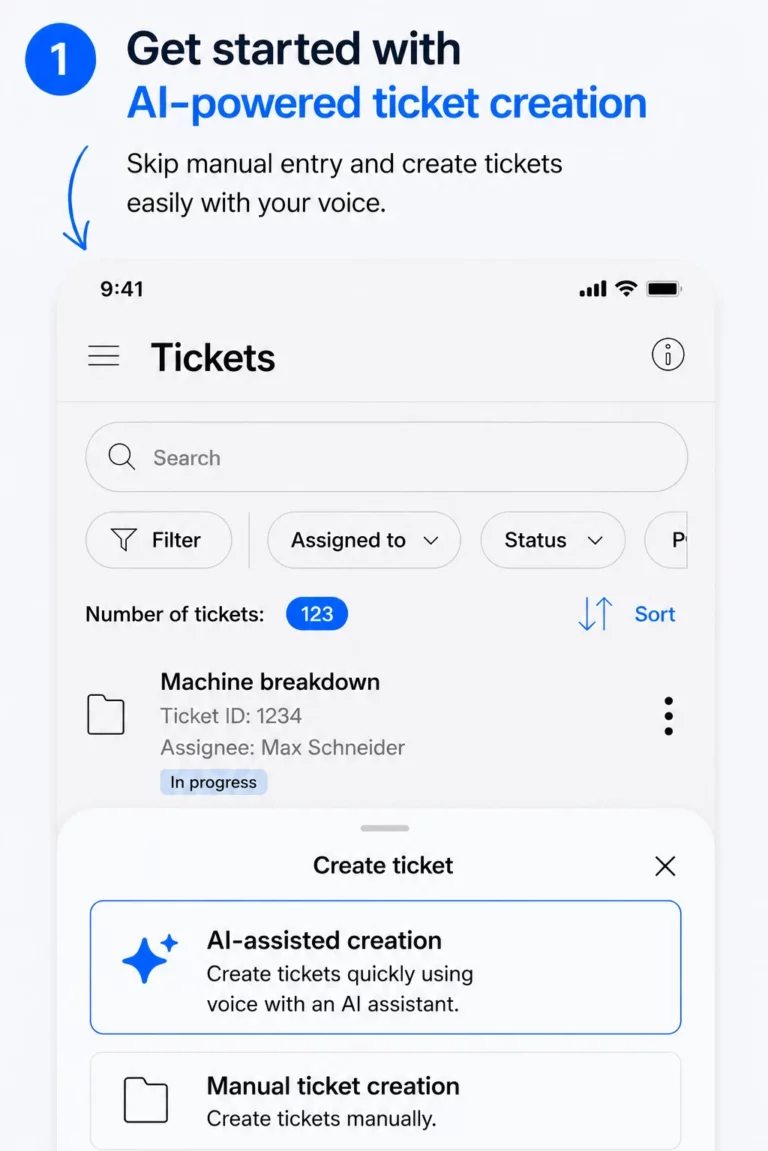
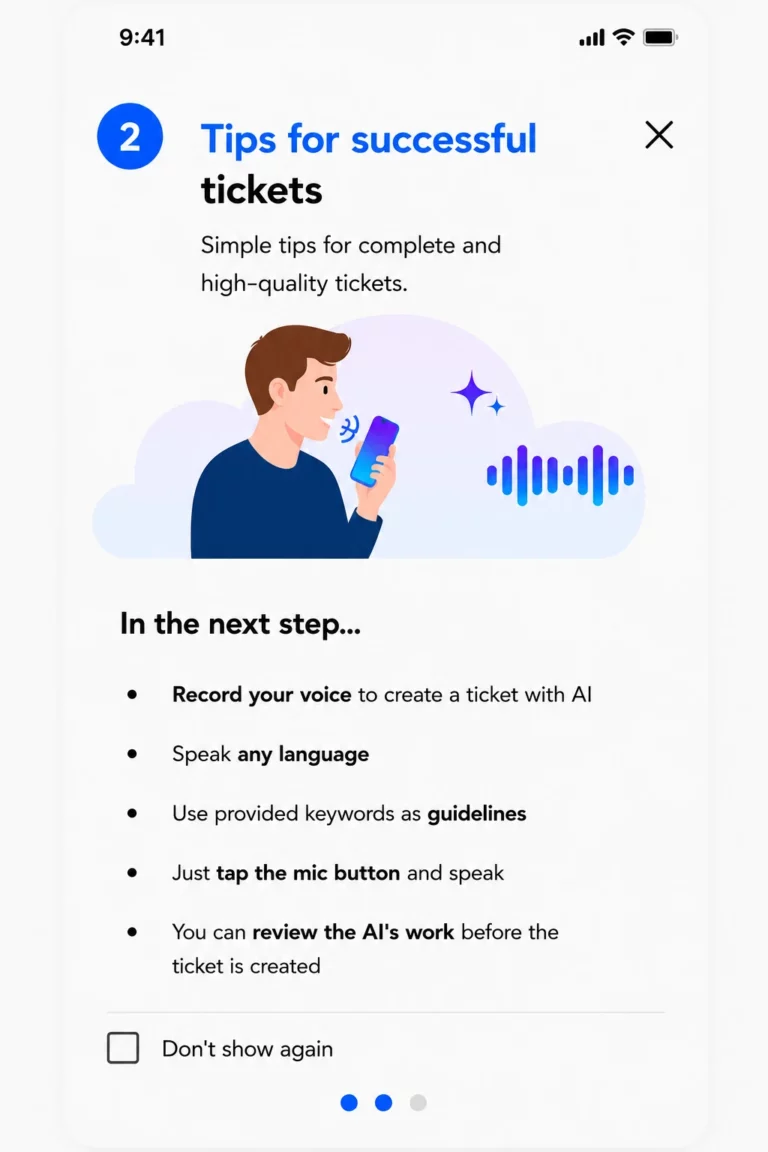
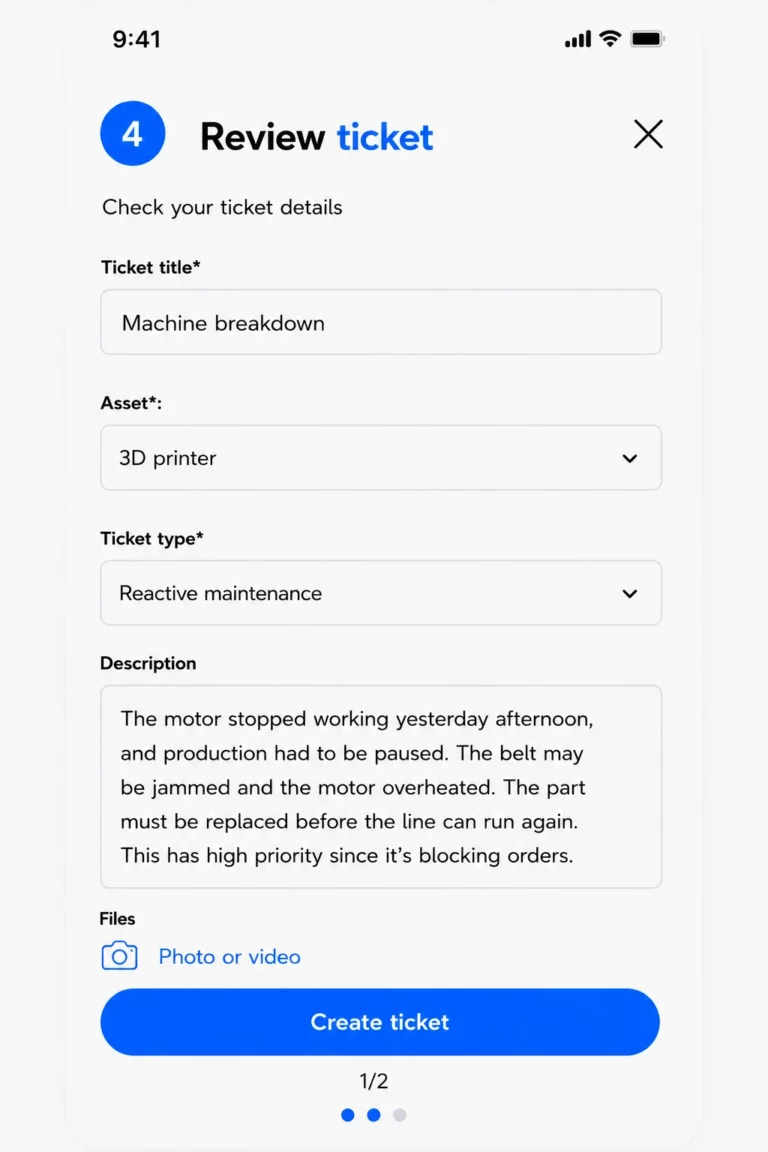
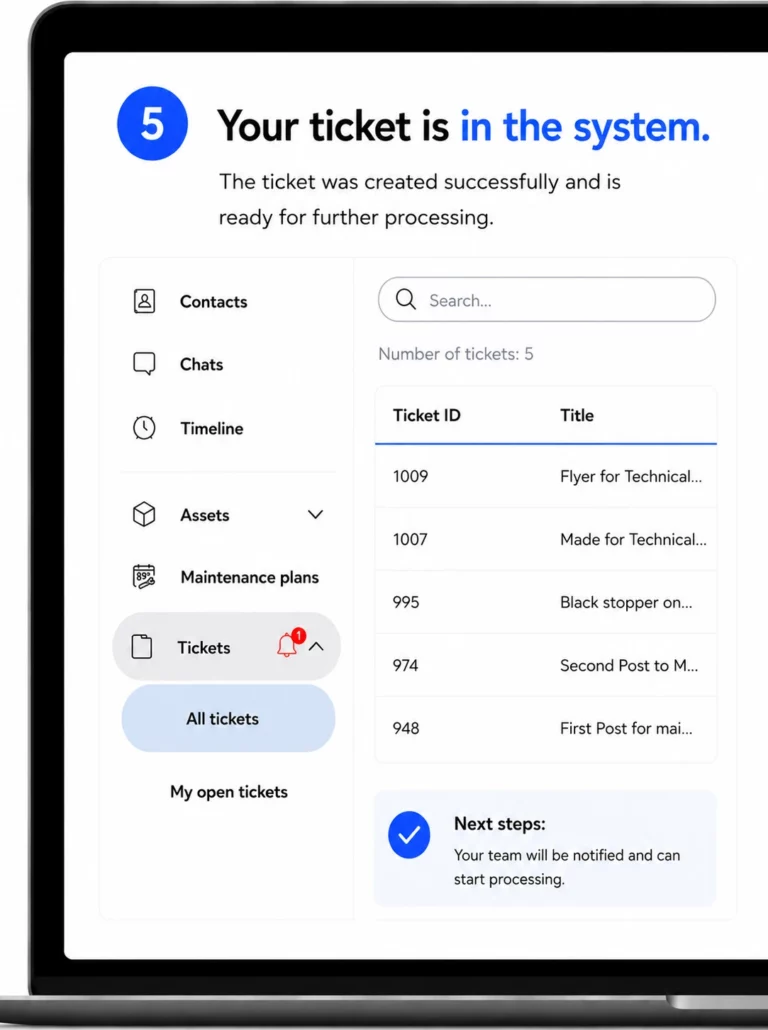
Once saved, the ticket appears immediately in the web view of the software – visible to the maintenance manager and the maintenance team in both the ticket area and the asset overview.
Voice-controlled systems and data privacy: what you need to know
Any company that captures speech digitally has every right to ask what happens to that data. In voice-controlled systems used in industrial environments, three questions matter most: what is stored, for how long, and who has access. Maintastic does not store the audio recording itself – only the structured ticket generated from it. Voice input is a means of capture, not an archive format.
What remains in the system is the information, not the recording. For companies that require verified proof of data security, Maintastic is certified to ISO 27001 – the internationally recognised standard for information security management. That means data security is not a promise. It is an audited and documented process. Beyond that, clear rules should govern which employees have access to which tickets – not every fault report is relevant to everyone in the organisation. AI-powered ticketing is not a security risk when a system consistently applies these principles – and at Maintastic, it does.
Why AI in the workplace is a practical advantage, not a risk
An important distinction needs to be made here: how AI is deployed, and how it is built and hosted. Many people instinctively think of widely used consumer AI tools such as ChatGPT or Google Gemini when the topic comes up. These are publicly accessible AI systems – meaning every user’s input contributes to training the underlying large language model (LLM), and every interaction is processed within a shared public environment. For a workplace handling sensitive operational data, that is not always the appropriate solution.
AI maintenance agents and AI speech assistants deployed within dedicated maintenance software are, as a rule, purpose-built for exactly that context. Data captured through these systems is not publicly accessible – it is used exclusively within the company’s own environment.
The core purpose of AI agents in this context is to reduce the time burden on production staff and technicians. That means simplifying processes that previously required extensive manual effort – not only issue reporting through Voice-to-Ticket technology, but also the tasks that follow: ticket prioritisation, task allocation and preparation of issue resolution measures. As a result, everyone involved can structure their time more effectively and focus on what matters, rather than spending a significant portion of their shift manually entering data into ERP systems or navigating cumbersome request workflows.
One concern that often comes up in connection with artificial intelligence is control over the data. In most AI speech assistants, the generated result is displayed for review before it is saved, allowing the content to be checked and adjusted manually. This mechanism – known as “human in the loop” – means full control remains with the employee at all times.
Maintastic’s CMMS (computerised maintenance management system) goes well beyond a ticketing system with AI-powered ticket creation and an AI maintenance agent within reactive maintenance.
Im Folgenden sind die Funktionen aufgeführt, die sich bei Kunden in der Praxis als zentral für ein modernes Instandhaltungsmanagement erwiesen haben.
Management of machines, assets and components including master data, serial numbers and location information.
Creation of cyclical maintenance plans for machines, inspection-critical or high-priority assets as part of preventive maintenance.
Overview of all open, in-progress and completed work orders including status, deadlines and feedback.
Provision of checklists, inspection protocols and maintenance instructions for standardised workflows in autonomous maintenance.
External Collaboration
Collaborate with machine manufacturers via live video and chat in the context of machines, fault reports and work orders.
Mobile access to essential functions – including AI-powered voice issue reporting, processing work orders, capturing feedback, completing checklists and viewing machine history.
Interfaces
Monitor conditions with IoT systems and automatically create tickets as part of predictive maintenance.
Level of customisation
Flexible system configuration through custom input forms and mandatory fields for tickets and work orders.
These features make Maintastic CMMS a suitable maintenance software solution across a wide range of industries. It is used not only in general manufacturing, process industries such as pharmaceutical industry or chemical manufacturing industry, construction and mining, but also in food production, transportation and intralogistics, and defence and security.
FAQ: Frequently asked questions about AI agents and AI-powered ticket creation
What are the advantages of a speech assistant in everyday working life?
Anyone standing at a machine rarely has both hands free for a form. With Maintastic, faults are reported on the spot by voice – the AI maintenance agent converts the input into a complete ticket. No detours, no information loss, no waiting until the next PC is within reach.
Is an internet connection required, or does voice capture also work offline?
AI-powered voice processing in Maintastic requires an active connection, as interpretation takes place server-side. For areas with limited Wi-Fi coverage, a stable mobile or network connection at the point of use is recommended.
Can the ticket generated by the system be reviewed or corrected before submission?
Yes – and that is a fixed part of the process. Maintastic displays the generated ticket immediately after voice capture for review. Fields can be adjusted, priorities corrected and missing information added. The employee retains full control before the ticket enters the system.
Does the speech assistant understand technical terms and industry-specific terminology from maintenance?
Yes – the Maintastic AI maintenance agent is designed for industrial environments and reliably processes technical terms such as “bearing damage”, “pressure loss” or asset-specific designations such as “pump P-07”. Unlike consumer speech assistants, the system is not built for everyday use – it is built for production operations.
Do I as a technician need to learn anything new to use the speech assistant?
No. The principle is straightforward: describe the problem the way you would explain it to a colleague – in your own words, without fixed structures or commands. Maintastic’s Voice-to-Ticket technology handles the rest. No separate instruction or training is required.
Are there data privacy concerns with voice-controlled systems?
A legitimate question. Maintastic does not store the audio recording itself – only the structured ticket generated from it. The voice input is a means of capture, not an archive. Data processing and storage comply with GDPR requirements. Maintastic is additionally certified to ISO 27001.
Take the next step in your maintenance operations
Get in touch and find out how AI-powered ticketing can support your operations. In a personal tour of our software, we’ll show you how Maintastic fits your wider requirements. Or get started straight away with a 14-day free trial.